

Who owns the carbon in the IT channel?
If a laptop's carbon passes through four companies before it reaches a desk, which of them is responsible for reducing it?
In the IT channel, the honest answer is: all of them, and none of them can do it alone. A vendor makes the device, a distributor moves it, a reseller or managed service provider sells and supports it, and an end customer runs it for years. Each step reports the same emissions in a different scope, from different data, under different pressures.
At AfterUs, we have worked with channel partners on their Scope 1–3 inventories and transition plans. What we see is that the channel is where technology decarbonisation tends to stall. Not for lack of intent, but because carbon flows forward through the chain while the data needed to measure it has to flow backwards, and the two rarely meet.
1. Vendors: the data exists, but it doesn't travel well
Most major hardware vendors now publish product carbon footprints. That should make life easy for everyone downstream. In practice it rarely does.
Different methods. Two laptops with similar specifications can carry very different footprints because their makers assumed different lifetimes, usage patterns or electricity grids.
Different formats. Footprints arrive as PDFs on product pages, not as data a distributor's systems can read across tens of thousands of product lines.
Software and services are thinner still. Licences, cloud subscriptions and security services make up a growing share of what the channel sells, and few come with a credible footprint at all.
The result is that most businesses further down the chain fall back on spend-based estimates: emissions calculated from what they paid, not what they bought. That is a reasonable starting point. It becomes a problem when it is the only method, because spend-based numbers rise with prices and fall with discounts, whatever happened to the carbon.
2. Distributors: a small footprint sitting on a very large one
A distributor's own operations are modest: warehouses, offices, vehicles. Its value chain is enormous. Almost everything material sits in Scope 3, in two places:
Purchased goods and services: the hardware and licences it buys from vendors.
Use of sold products: the electricity those devices consume over their working lives, in customers' offices and data centres.
Both depend on data the distributor does not control. The vendor holds the product data; the end customer decides how long a device runs and on which grid. The distributor sits in the middle, accountable for numbers it can only estimate.
Three things make it harder:
Many countries, many systems. A pan-European distributor is often a federation of acquired businesses, each with its own ERP, product codes and finance calendar. Getting consistent data out of them is usually harder than the calculation itself.
Mergers and acquisitions. The channel consolidates constantly. Every acquisition, merger or carve-out changes the boundary, and a baseline set two years ago can stop describing the business overnight. Without a clear recalculation policy, targets end up met, or missed, on paper.
Ownership. Many distributors are now private equity-backed. Investors ask for portfolio ESG data each spring, usually through the ESG Data Convergence Initiative, on their timetable and to their standard. Carbon reporting moves from the marketing team to the finance team, and the tolerance for rough estimates drops.
3. Resellers and MSPs: reporting built for tenders, not for investors
For many UK resellers and managed service providers, the main carbon document is a Carbon Reduction Plan written for public sector bids. Under the government's procurement rules (PPN 06/21, now PPN 006), that plan needs Scope 1, Scope 2 and only a handful of Scope 3 categories: business travel, commuting, waste, upstream transport and downstream transport.
That is a sensible minimum for a tender. But for a business whose model is buying technology and selling it on, it leaves out the categories that matter most: the hardware, licences and network services it buys, and the energy those products use once sold. A plan can be fully compliant and still describe a small fraction of the real footprint.
Two further pressures are building:
Customer scrutiny. Enterprise customers increasingly want Scope 3 figures and EcoVadis ratings from their suppliers, not just a tender document.
Infrastructure shifts. When an MSP sells its data centres but keeps hosting in them, or moves into colocation, emissions move from Scope 1 and 2 into Scope 3. The total may barely change, but the reported numbers look very different, and the baseline needs restating before anyone can claim progress.
4. End customers: where the biggest reductions actually happen
The end customer controls the two levers with the largest effect: how much energy the equipment uses, and how long it stays in service. Keeping a laptop or server running for an extra year or two, and then refurbishing or reselling it rather than recycling it, avoids the manufacturing emissions of a replacement.
The channel is well placed to deliver this. Resellers and distributors run device-as-a-service, refurbishment and IT asset disposal businesses. The difficulty is accounting for it:
There is no settled way to credit a reseller for extending the life of a product it sold and later bought back.
Refurbished devices often re-enter the market without the original product footprint attached.
Customers ask suppliers for lower-carbon options but rarely share the usage data that would show whether those options worked.
So the most effective decarbonisation lever in the chain is also the hardest to see in anyone's numbers.
5. The through-line: carbon flows forward, data flows back
Put the four steps side by side and the pattern is clear. The same emissions are counted at every step: as manufacturing at the vendor, as purchased goods at the distributor and reseller, and as use and disposal at the customer. That double counting is by design in Scope 3; it is how shared responsibility works. But it only produces reductions if each step can see, and influence, what the others are doing.
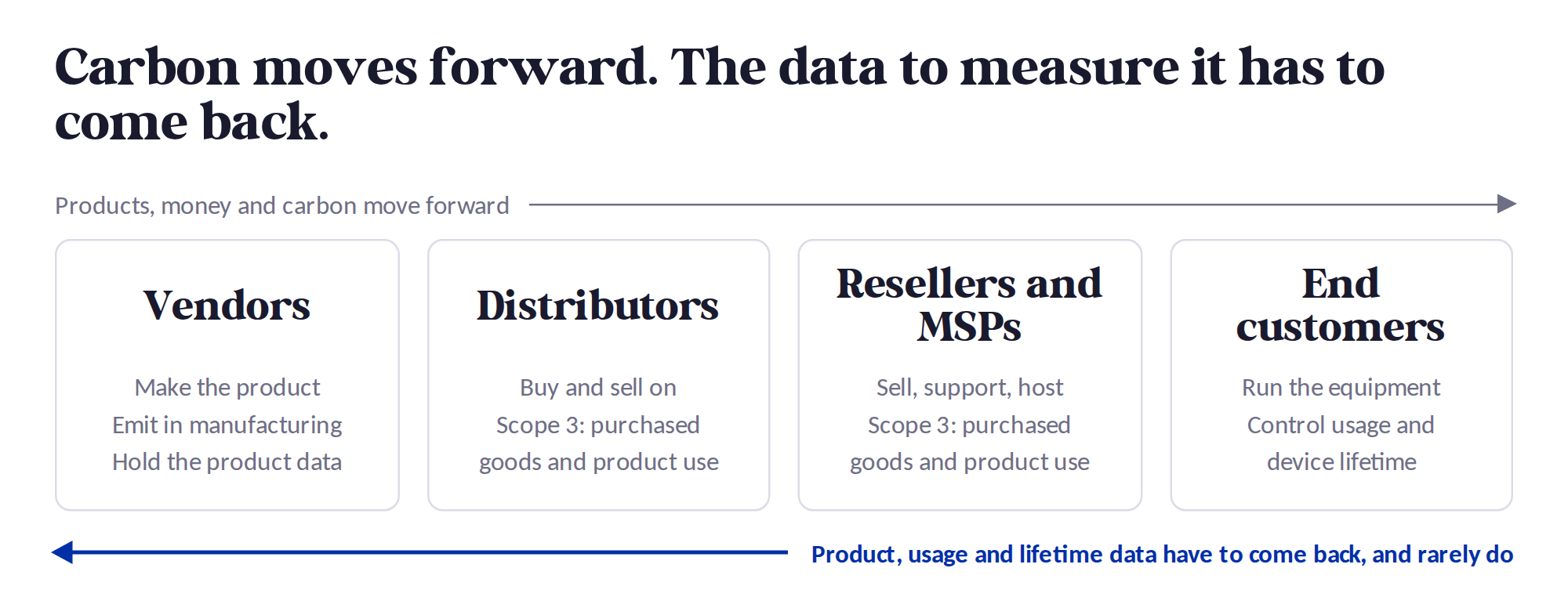
Product, usage and lifetime data have to come back, and rarely do
The rules are tightening around exactly that point:
SBTi. The Corporate Net-Zero Standard V2.0 was published on 11 June 2026 and opens for validation on 1 February 2027. The current version stays open to the end of 2027, so many channel businesses face a real choice about which standard to set targets under.
CSRD. The EU's Omnibus changes narrowed the scope to groups with more than 1,000 employees and €450m turnover, but the largest distributors remain in it, with double materiality and data that has to survive assurance.
UK SRS. The UK's version of the ISSB standards was finalised in February 2026, and the FCA has proposed mandatory use for listed companies for periods from 1 January 2027.
Green claims. The EU's Empowering Consumers for the Green Transition Directive has applied since 27 September 2026. It bans generic environmental claims that cannot be substantiated, sustainability labels outside approved schemes, and product claims of carbon neutrality based on offsets. The separate Green Claims Directive stalled after the Commission moved to withdraw it in June 2025. In the UK, the CMA has been able to fine directly for misleading green claims since April 2025.
Product passports and circularity. Under the EU's Ecodesign for Sustainable Products Regulation, digital product passports will carry repairability, material and environmental data with the product itself. The central EU registry went live in July 2026, batteries come first from February 2027, and requirements for electronics are expected later in the decade. When they arrive, data that today stops at the vendor will have to travel through the channel, and refurbishers will need it too.
Customers and investors. EcoVadis, CDP and private equity reporting all ask for Scope 3, on their own timetables.
6. What each step can do now
None of this needs to wait for perfect data. It needs each step to fix what is in its own hands.
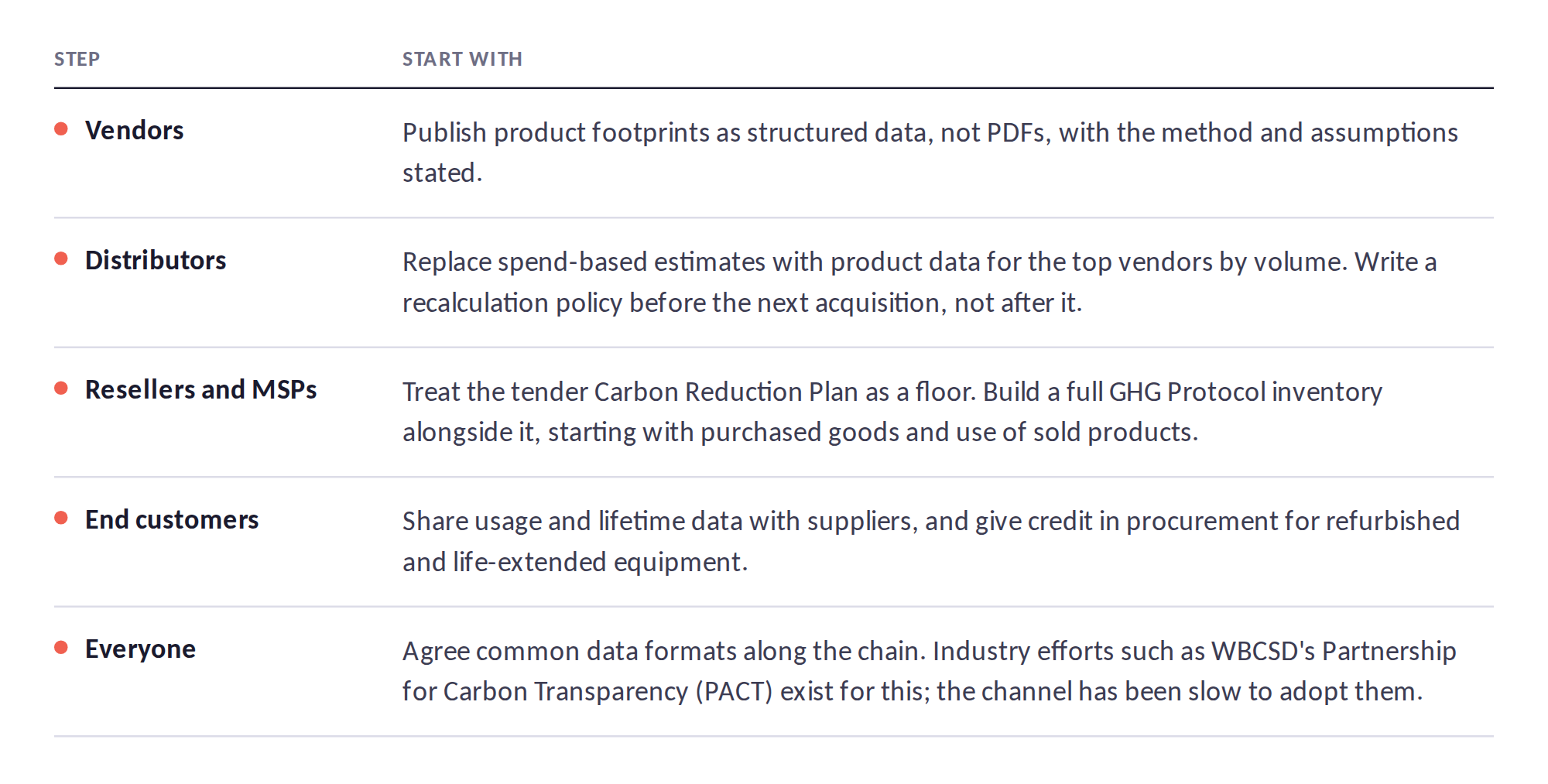
And for anyone setting targets in the next twelve months: decide the baseline and the standard before choosing the number. A target set on a baseline that no longer describes the business, or under a standard about to change, is the most expensive kind to revisit.
A question for the channel
The channel sits between almost every technology vendor and almost every business customer. That makes it the natural place to connect product data with customer use, and to make life extension count.
So, to vendors, distributors, resellers and MSPs: where does the data break down in your part of the chain, and who do you think should fix it?
AfterUs Advisory is an independent carbon accounting and sustainability strategy practice. We have worked with channel partners on group carbon inventories, targets and transition plans.